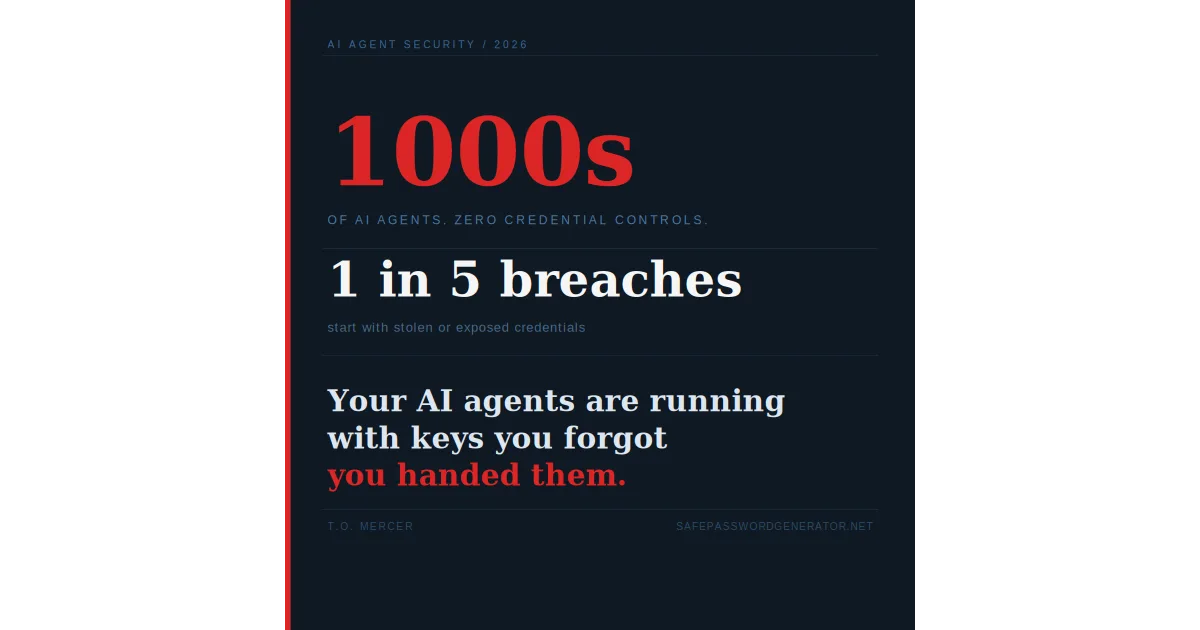
As we shift from simple chatbots to autonomous agents that book meetings, call APIs, and trigger workflows, we've created a massive new attack surface: Non-Human Identities (NHI). These are the bots, scripts, and AI agents that need authenticated access to systems, just like humans do. Unlike humans, nobody is managing their credentials properly.
As someone tracking the shift from SaaS to agentic workflows over the past few years, this pattern is familiar. The tooling always outpaces the security. This is no different.
The Rise of Non-Human Identities (NHI)
Why Human Identity Management Is No Longer Enough
For years, identity management meant managing people. You gave employees accounts, enforced MFA, and revoked access when someone left. That model worked when humans were the only ones logging in.
AI agents operate differently. A single agent can authenticate against dozens of services simultaneously, operate continuously without supervision, and accumulate credentials across every system it touches. The volume is exponential compared to human identities, and the oversight is close to zero.
| Feature | Human Identity | Machine Identity (AI Agent) | Risk Level |
|---|---|---|---|
| Volume | 1 per employee | Thousands of scripts | Critical |
| Authentication | MFA / Biometrics | Certificates / Tokens | High |
| Behavior | Predictable / Slow | High-speed / Automated | High |
| Monitoring | Login logs | API audit trails | Medium |
| Credential storage | Password manager / SSO | Often hard-coded | Critical |
| Revocation | HR offboarding | Manual / Often skipped | High |
The combination of high volume, automated behavior, and hard-coded credentials is what makes machine identity management a fundamentally different problem than anything the industry has solved before.
The Risk: How AI Agents Leak Credentials
The danger isn't just that AI agents are new. It's that they're being built on old, broken habits. Most development teams are handing agents access the fastest way possible, including through Shadow AI: unauthorized agents deployed by employees that IT never approved and can't see.
- Hard-coded API keys: sk-abc123xyz sitting in a script where any contributor can see it
- Plaintext .env files: environment variables accidentally committed to version control
- Prompt exposure: tokens pasted into chat interfaces, captured in logs or training data
- Shadow AI: agents accumulating unmanaged credentials across systems with no central oversight
There is a compounding risk that most coverage misses: prompt injection. If an attacker manipulates an agent through malicious input, they don't just compromise that conversation. They inherit every credential that agent holds. If those credentials are long-lived and broadly scoped, a single injection attack becomes a full production breach. Scoped, just-in-time credentials are the only structural defense against that scenario.
IBM's Cost of a Data Breach report found stolen credentials appear in nearly 1 in 5 breaches. Agents make that surface area dramatically larger.
1Password Unified Access: A 3-Step Security Framework
1. Discover
The platform scans endpoints, browsers, and developer environments for agent activity and exposed credentials. It surfaces plaintext environment files, unencrypted SSH keys, and tokens in config folders. This is the Shadow AI audit most organizations have never run.
2. Secure
Credentials move into an encrypted vault. Embedded keys are replaced with runtime references. The difference in practice:
Agents request a secret at runtime, the platform enforces policy and scope, only the authorized process receives it. Rotation and revocation happen in one place without touching code.
3. Audit
Every access event is logged with full attribution: which agent, which credential, which system, at what time. That trail satisfies SOC 2 Type II and ISO 27001 audit requirements and gives incident responders a clear timeline when something goes wrong.
Your AI Tools Are Only as Safe as Your Credential Hygiene
Even if your organization isn't deploying enterprise AI agents today, the same habits that expose production environments start with reused passwords and unrotated API keys. A password manager is the baseline defense.
NordPass is what I recommend for teams and individuals managing credentials across multiple services.
Try NordPass FreeAffiliate link. I may earn a commission at no extra cost to you.
Vendor-Agnostic vs. Ecosystem Security: Microsoft vs. 1Password
Microsoft has previewed an identity layer for AI agents within its ecosystem. It's a credible solution if your entire stack runs on Azure and Microsoft 365. Most production environments don't.
The average organization spans multiple clouds, CI/CD platforms, and SaaS tools. A security layer scoped to one vendor leaves the rest of the environment unmanaged. 1Password's positioning is vendor-agnostic, built to work across heterogeneous stacks rather than inside a single platform's walls.
In practice, most teams will run overlapping solutions: cloud IAM for coarse-grained access control, and a dedicated secrets platform for fine-grained, just-in-time delivery with a full audit trail. Those aren't competing approaches; they're complementary layers.
Actionable Lessons for Personal AI Safety
Unified Access is an enterprise product. But the credential problem it solves isn't exclusive to enterprise environments. The pattern is the same at every scale: credentials stored carelessly, reused across too many places, and never rotated until something goes wrong.
- Use a password manager to generate and store unique credentials for every service
- Revoke API access for AI tools and apps you no longer use
- Never reuse credentials across services
- Review connected app permissions regularly, especially for AI tools with broad access
1Password built a platform to enforce that discipline for machines. A password manager and these four habits cover most of the same ground for everyone else.
Related Reading
- McKinsey AI Hack: How an AI Agent Breached Lilli in 2 Hours: The real-world case study of what an agentic attack looks like in production
- MCP Security: 53% of Servers Store Your Keys in Plaintext: How to audit and harden your MCP environment
- Vibe Coding Security: 7 Flaws Your AI Forgot to Fix: A checklist for securing AI-generated code before launch
Frequently Asked Questions
What is an AI agent credential?
An AI agent credential is a secret, typically an API key, token, or password, that allows an AI agent to authenticate and act on behalf of a user or system.
What are Non-Human Identities (NHI)?
Non-Human Identities are machine entities such as bots, scripts, and AI agents that require authenticated access to systems. Unlike human identities, they are often unmanaged and accumulate credentials without oversight, creating compounding exposure at scale.
How does 1Password Unified Access work?
It scans for exposed credentials, moves them into an encrypted vault, and provides them to agents at runtime under policy controls. Every access is logged with full attribution for compliance and incident response.
Why is hard-coding API keys dangerous?
A hard-coded key stored in code or config files is permanently accessible to anyone who gains access to that environment. It has no expiration, no scope limit, and no audit trail, making it one of the most exploitable patterns in modern infrastructure.
What is Shadow AI?
Shadow AI refers to AI tools and automation scripts deployed by employees without IT department approval or oversight. Each requires access to something, and none are being managed centrally, creating hidden credential exposure across the organization.
What is prompt injection and why does it matter for credentials?
Prompt injection is an attack where malicious input manipulates an AI agent into taking unintended actions. If that agent holds broadly scoped credentials, a successful injection gives an attacker access to every system the agent can reach. Scoped, just-in-time credentials limit the blast radius of that scenario.
How does 1Password Unified Access help with SOC 2 or ISO 27001?
The audit trail generated by Unified Access logs every credential access with attribution, supporting the access control and monitoring requirements in both SOC 2 Type II and ISO 27001 frameworks.
Is 1Password Unified Access for individuals?
Currently it is an enterprise product. Individual users are better served by a standard password manager combined with strong credential hygiene.
What is a runtime secret?
A credential provided to a process only while it is running, rather than stored permanently in code. Runtime secrets reduce the exposure window dramatically if an environment is compromised.
Does Microsoft have an equivalent AI agent security tool?
Microsoft has previewed an identity layer for agents within its ecosystem, primarily scoped to Azure and Microsoft 365. It is not designed for cross-platform or multi-cloud environments.
Sources
- FindArticles: 1Password Debuts Tool To Tackle AI Agent Credential Risk (March 17, 2026)
- IBM Cost of a Data Breach Report 2025/2026
- OWASP Top 10 for Large Language Model Applications
T.O. Mercer | SafePasswordGenerator.net