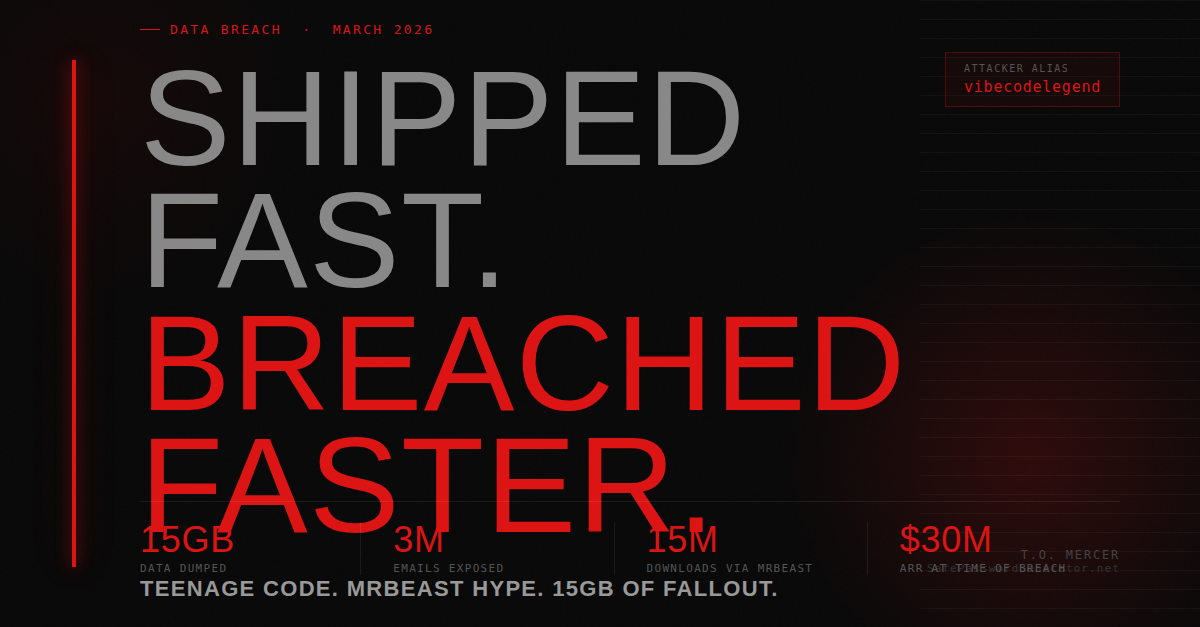
Quick take: The Cal AI breach leaked health data for roughly 3.2 million people. It is not a one-off incident. It's the 21st entry in a growing list of AI-powered apps that shipped fast, skipped basic security, and ended up dumping private data onto a dark web marketplace.
If this feels familiar, it's because it is. Between January 2025 and February 2026, researchers documented at least 20 AI app breaches with the same root causes: misconfigured databases, missing Row Level Security, hardcoded API keys, and unauthenticated cloud backends. One independent review of AI apps found that over 70% shipped with exposed secrets or broken access controls, a pattern confirmed by security research on AI app breaches.
Cal AI is simply the first big health app to get caught. It won't be the last.
What Happened in the Cal AI Breach
Cal AI is a viral calorie and health tracking app that lets users log meals, weight, and workouts. In early March 2026, a security researcher discovered that Cal AI's backend database was exposed without proper authentication. Within days, a 14.59 GB dump appeared on a dark web marketplace.
Based on the leaked dataset and subsequent analysis, the breach exposed:
- Full names and email addresses
- Dates of birth, heights, and body weights
- Meal and nutrition logs, including timestamped entries
- Subscription history and partial payment metadata
- At least one record belonging to a child born in 2014
In total, roughly 3.2 million user records were exposed, enough to build detailed health profiles that can be abused for phishing, extortion, or insurance fraud.
Why Vibe-Coded Apps Keep Getting Breached
Cal AI was not built by a malicious team. It was built the same way most fast-growing apps are built in 2026: copy a Supabase or Firebase tutorial, wire up some React components, deploy to Vercel, and ship. That "move fast and ship vibes" approach works for prototypes. It fails catastrophically for production user data.
At a technical level, Cal AI's stack looks nearly identical to the 20+ AI app breaches before it:
- Supabase or Firebase backend with permissive rules
- Row Level Security disabled or misconfigured
- Hardcoded API keys in the frontend bundle
- No authentication layer on admin or analytics endpoints
This is exactly why vibe-coded apps have a security problem by design. The defaults optimize for developer speed, not safety. Unless someone on the team has read the database security docs and applied them correctly, the app will eventually leak something important.
Why This Breach Is Worse Than "Just Another Leak"
Health data lives at the intersection of privacy and discrimination. An attacker who knows your weight history, eating patterns, and sleep schedule can craft far more convincing phishing campaigns than one who just has your email address.
We've already seen that attackers pair fresh leaks with credential stuffing. In our 19 billion passwords analyzed report, we found that reused passwords are still the fastest path from "one breach" to "dozens of compromised accounts." Cal AI adds a twist: the data is valuable even if you never reused a password.
Expect to see:
- Highly targeted phishing emails referencing specific diet or workout logs
- Insurance scams using leaked health metrics
- Account takeover attempts on any service where you reused your Cal AI password
What You Should Do If You Used Cal AI
1. Change Your Cal AI Password (And Any Reused Ones)
First, assume your Cal AI password is compromised. If you reused it anywhere else, those other accounts are at risk. This is exactly the scenario we covered in why changing your password sometimes isn't enough: attackers chain one leak into many.
- Change your Cal AI password to a unique, 16+ character password.
- Audit other accounts where you might have reused the same or similar password.
- Enable multi-factor authentication (MFA) wherever possible.
2. Check If Your Email Is in Other Breaches
Use Have I Been Pwned or a similar service to see where else your email has shown up. Set up breach alerts so you get notified when your address appears in future leaks.
3. Watch for Health-Themed Phishing
Attackers tend to weaponize fresh breach data within days. Be skeptical of:
- "We noticed unusual activity in your calorie log" emails
- Fake subscription renewal notices for Cal AI or related apps
- Health survey scams that reference specific habits or stats
If you're not sure how to respond to future incidents, bookmark our Betterment guide on how to respond to any data breach in the next 20 minutes. The playbook is the same regardless of which company leaked your data.
How to Protect Yourself From the Next "Cal AI"
You can't stop startups from shipping insecure code, but you can make yourself a far less attractive target:
- Use a modern password manager and unique passwords everywhere.
- Prioritize passkeys for accounts that support them.
- Segregate email addresses: use a separate address for health apps than for banking.
- Regularly review which apps have access to your health data and revoke what you don't need.
The Cal AI breach is one more proof point that convenience apps built on vibe-coded stacks will keep leaking data until security becomes a non-negotiable requirement, not an afterthought. You can't control their roadmap. You can control how much damage their mistakes can do to you.